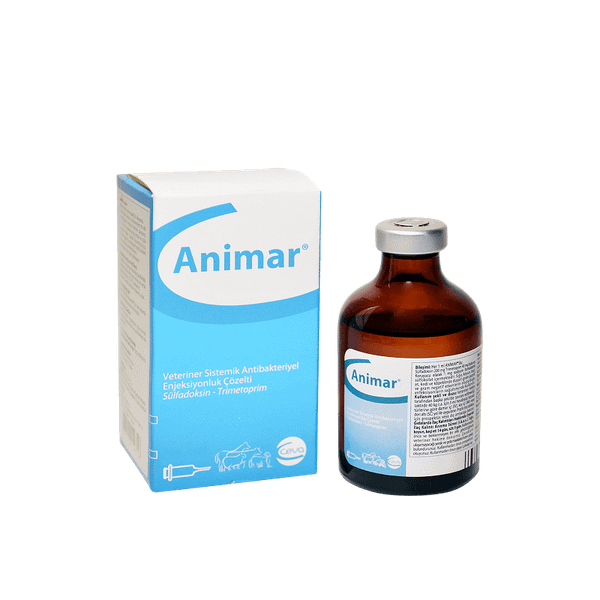
ANIMAR / 40 MG TRIMETHOPRIM AND 200 MG SULFADOXINE / 100 ML
$ 90.85
Animar / 40 mg Trimethoprim and 200 mg Sulfadoxine / 100 ml COMPOSITION Animar is a light yellow, light odor clear solution, in every 1 ml; Sulfadoxine 200 mg Trimethoprim 40 mg. PHARMACOLOGICAL PROPERTIES Trimethoprim and sulfadoxine in the composition of Animar, when used in combination, creates a bactericidal effect by blocking the folic acid synthesis of bacteria in two stages, thanks to the synergism between them. Sulfadoxine interrupts folic acid synthesis by preventing the synthesis of dihydrofolic acid from PABA; Trimethoprim prevents the reduction of dihydrofolic acid to tetrahydrofolic acid. Thus, it prevents DNA synthesis in bacteria. Sensitive bacteria: Gram positive aerobes: Staph. aureus, Streptococcus sp., Actinomyces sp., Corynebacterium sp., Listeria monocytogenes, Erysipelothrix rhusiopathie Gram negative aerobes: Actinobacillus sp., Bordetella sp., Enterobacteriaceae (E. coli, Klebsiella sp., Proteus sp., Salmonella sp., Yersinia sp.) Haemophilus sp., Pasteurella sp. Anaerobes: Actinomyces sp., Bacteroides sp., Fusobacterium sp., Some Clostridium sp., Chlamydia sp. Some Mycobacterium sp. and some Nocardia sp. moderately sensitive. Rickettsia sp., Leptospira sp., Pseudomonas aeroginosa, Mycoplasma sp. considered resistant. After parenteral administration of Animar, it is rapidly absorbed from the place of administration, reaching effective blood density within 1 hour and peak plasma density within approximately 4 hours. It is rapidly distributed in body tissues and fluids. It binds to plasma proteins and 50-60% of it is excreted in the urine within the first 24 hours. INDICATIONS It is used in the treatment of infections caused by sensitive gram-positive and gram-negative factors (digestive, respiratory, urogenital system and soft tissue infections, secondary bacterial infections accompanying viral diseases) in cattle, sheep, goats, horses, cats and dogs. USAGE AND DOSAGE Unless recommended otherwise by the veterinarian, with the calculation of 30 mg Trimethoprim Sulphadoxine / kg live weight; Cattle, calves and calves: Every 40 kg b.w. 5 ml for - intravenous (iv), intramuscular (im) or subcutaneous (sc) For sheep, goats, lambs: Every 20 kg bw. 2.5 ml for - intravenous (iv) or intramuscular (im) Dogs and cats: Every 8 kg bw. For 1 ml - administered intramuscularly (im). Usually a single injection is sufficient. Depending on the type and severity of the infection, the same dose can be repeated after 24-48 hours. Intravenous injections in horses should be done slowly and close to body temperature. Asepsis conditions must be observed in practice. Alcohol and other disinfectants should not be used for asepsis of the syringe and needle. SPECIFIC CLINICAL INFORMATION AND WARNINGS FOR TARGET SPECIES Considering that sulfonamides may cause nephrotoxic effects (crystalluria, tubular obturation, hematuria, etc.) in dehydration states and acidic urine environment, care should be taken not to dehydrate the animals during treatment. Use in pregnancy: Sulfanamide-diaminopyrimidine mixtures cross the placenta. No side effects were seen in the treatment doses in pregnant dogs. Its safety in pregnant horses has not been studied. There was no noticeable change in spermatogenesis in stallions at the recommended doses. Teratogenic effects were determined at very high doses in pregnant rats and mice. SIDE EFFECTS Although side effects related to sulfonamides are extremely rare, long-term repeated administration of sulfonamides may cause crystalluria, anemia and prothrombonemia, especially in dehydrated animals, and allergic reactions in animals sensitive to sulfonamides. Likewise, long-term repeated administration of sulfonamides may cause diarrhea, anorexia, nausea, vomiting and impairment of kidney function in animals. Folate deficiency may occur in animals receiving long-term sulfonamide therapy. In rare cases, it may cause swelling at the injection site in subcutaneous applications. In all dogs, especially Doberman-Pinscher dogs, they may cause idiosyncratic poisoning characterized by impaired blood picture, nonseptic polyarthritis and skin rash. Sulfonamide-diaminopyrimidine combinations should not be used in animals with liver damage and allergies to these combinations. It should be used with caution in newborn animals. Their long-term use can lead to hepatoxicity and hypothyroidism. Although rare, respiratory and cardiac shock may occur in horses following intravenous administration. For this reason, the product should be at body temperature and should be done as slowly as possible. Long-term use in dogs can lead to keratoconjunctivitis sicca. In all species, they can cause crystal formation in the urinary system. Therefore, this issue should be taken into consideration when using in severely dehydrated animals. In order to alleviate the effects on the kidneys, the patient's hydration should be ensured to be healthy, and urine should be alkalized when necessary. INTERACTIONS Sulfonamides should not be used in combination with para-aminobenzoic acid (PABA), which is their structural analogue, and local anesthetics such as procaine and butocaine with PABA nuclei in their structure. Likewise, procaine should not be used together with penicillin G as it may have an antagonistic effect. When given with ammonium chlorite and urine acidifiers, it may cause crystalluria in the urinary system. B complex vitamins such as nicotinamide, folic acid, choline, and amino acids such as glutamic acid and methionine, which are their precursors, can have an antagonistic effect with sulfonamides. Since their use with diuretics may cause a decrease in the platelet count, they should not be used with these drugs. Supplementary enzymes, glucose and sublime should not be used together as they are antagonist to sulfonamides. Cardiac arrhythmia, which can be fatal, can occur in combination with alpha-2 receptor agonists. Therefore, they should not be used intravenously in horses sedated with Alpha -2 agonists. FOOD WARNINGS Residue Removal Time (İ.K.A.S.): Cattle, sheep and goats should not be sent to slaughter during the treatment and before 14 days after the last drug administration. Cow, sheep and goat milk obtained during the treatment and for 5 days (10 milkings) after the last drug administration should not be offered for consumption. CONTRAINDICATIONS It should not be used in animals sensitive to sulfonamides and with severe hepatic and renal dysfunction. WARNINGS Consult your veterinarian before using and in case an unexpected effect is observed. Keep out of reach of children and away from foodstuffs. Do not purchase or use products with expired shelf life and damaged packages. PRECAUTIONS People known to be sensitive to sulfonamides should not come into contact with the drug in any way. Immediate medical intervention is required if symptoms such as swelling of the face, eyes or lips, difficulty in breathing occur after exposure to the drug by mouth, skin or inhalation of sensitive persons. STORAGE CONDITIONS AND SHELF LIFE Store in its own packaging in a cool and dry place at room temperature (15-25 C).